ESO

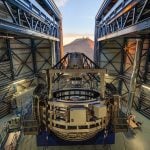
A large telescope - 4MOST - is seen pointing to the sky from its structure in Chile.
26
Nov

‘A census of galaxies’: How Australia is helping map our local Universe

Astronomers are using Australian technology, expertise and software to create the most complete galaxy census of the local Universe.
Read More
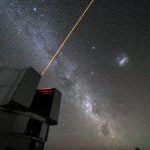
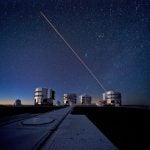
ESO's Very Large Telescope is visible with the night sky above. A laser shoots out from the telescope to help it focus.
03
Apr

Statement on the future of Australia’s partnership with ESO

We note the Federal Government’s decision not to pursue full membership with the European Southern Observatory (ESO) once the current Strategic Partnership ends in 2027.
Read More
12
Mar

Astronomy delivers $330m to Australian economy each year: New analysis

Australian astronomy has added $3 billion to the economy over the past decade, according to new analysis from UNSW economist, Professor Richard Holden.
Read More
Artist's concept of the BlueMUSE instrument, to be installed on ESO's Very Large Telescope (VLT). Image credit: BlueMUSE/University of Lyon
04
Feb

The Australians helping uncover the blue universe

Australian researchers and engineers are helping design and deliver a new instrument for one of the world’s most productive telescopes.
Read More
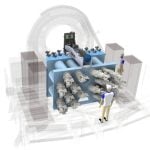
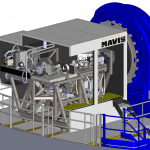
A CAD image of the MAVIS instrument. Credits to Gaston Gausachs, Astralis-AITC
21
Aug

MAVIS: A bold leap in Australian-led Astronomy and Adaptive Optics

MAVIS is a next-generation instrument that will deliver the sharpest optical images of the Universe ever achieved from Earth. Designed for installation on ESO’s VLT in Chile, MAVIS is led by ANU through the Astralis Instrumentation Consortium, in partnership with Macquarie University, the University of Sydney, and international collaborators...
Read More
Alt text: In this artist’s impression, three cream and pink coloured galaxies are jumbled together in the upper left corner. From this group, a bright yellow streak points towards the bottom right, where it intersects with a dot on a spiral arm of the Milky Way. The Milky Way, with a glowing white centre and blue-purple spiral arms, stands out against the black background faintly speckled with distant galaxies.
23
Oct

Record-breaking fast radio burst discovery highlights synergies between ESO and SKA

A global team led by Macquarie University’s Dr Stuart Ryder and Swinburne University of Technology’s Associate Professor Ryan Shannon have discovered the most distant fast radio burst ever detected, and one of the most energetic. The team determined its location and distance from Earth by using a combination...
Read More
13
Dec

ESO delegation visits Australia

A delegation from the European Southern Observatory (ESO) recently visited Australia between 28 November and 2 December 2022. The delegation was led by Professor Xavier Barcons (ESO Director General) and included Professor Linda Tacconi (ESO Council President) Ms Laura Comendador Frutos (Head of Executive Office of the Director...
Read More
22
Aug

Australian ESO Proposal Workshop 2022

AAL and Australia’s ESO Scientific Technical Committee and Users Committee representatives (Michael Murphy and Sarah Sweet, respectively) would like to invite our community to an on-line ESO proposal writing workshop to be held on Thursday 8 Sep from noon-2:30pm AEST (10am-12:30pm AWST).
Read More
16
Aug

Australian-based astronomers to take a deep dive into the cosmos with time awarded on one of ESO’s most powerful instruments

Two teams of astronomers led by The University of Sydney and by The University of Western Australia node of the International Centre for Radio Astronomy Research (ICRAR/UWA) have recently each been awarded substantial amounts of observing time on one of the most in-demand instruments at the European Southern...
Read More
05
Jul

AAL awarded additional $1.4M for the GWDC and ESO-related computing projects

AAL has been awarded an additional $1.4M from the National Collaborative Research Infrastructure Strategy (NCRIS) program to support the Gravitational Wave Data Centre (GWDC) and computing projects related to the European Southern Observatory (ESO).
Read More
1 2 3 4