Meet the teams planning Australia’s next space telescope missions

A multitude of Australian space missions are preparing for launch! From rendezvousing with asteroids, taking selfies in space, and searching for planets around our nearest star, Australian astronomers and space engineers are leading the way in innovative space mission design. 
 
In November, mission teams, astronomers and engineers from across the country will gather for Blue Horizons, an annual space astronomy conference to celebrate and prepare for the future of Australian space astronomy.
 
“Blue Horizons is a chance for the community to come together and learn about our current Aussie space missions, mingle with the minds behind Australia’s most innovative space astronomy tech, and start to plan for that next major mission together.” said Blue Horizons Chair and Head of Space Domain Awareness Projects at the University of Melbourne, Dr Sarah Caddy.
 
Held at the Australian National University on November 12-13, Blue Horizons will feature talks from space missions already funded and launching as soon as next year, alongside exciting mission concepts for the years ahead.
 
Keynote speakers include:
  • Dr Tim Parsons (HEO), the mission leader for Aussie company HEO’s ambitious Apophis asteroid flyby mission;
  • Professor Erika Hamden (University of Arizona), a leader in space astrophysics and space telescope design helping early career scientists develop their own space missions; and
  • Dominic Shumilin (Australian Space Agency), Assistant Director (India and Space Security) with valuable expertise in international space collaboration and strategic engagement.
Mission teams from across the country will discuss their plans, including:
  • Project SWIFT, led by Optus, which seeks to build, launch and operate a sovereign low Earth orbit satellite featuring an astronomy payload for exoplanet detection;
  • The Ultraviolent Extinction Sky Survey (UVESS), led by the Australian National University, which plans to measure UV extinction curves across the sky to reveal the composition and size distribution of interstellar dust grains;
  • The SkyHopper Infrared Space Telescope, led by the University of Melbourne, which will hunt for afterglows of the most energetic explosions in the Universe;
  • The Raven Smart Space Camera, also led by the University of Melbourne, with a telescope array for Earth and space imagery flying on the Gilmour Space Technologies MMS-2 mission in 2027.
  • The TOLIMAN Space Telescope, led by the University of Sydney and launching as early as 2027, which will search for Earth analogue planets in Alpha Centauri, our nearest neighbour star system.
“Every year at Blue Horizons I’m blown away by the progress the Australian community is making in designing, building, launching and operating our very own space telescope missions.” Dr Caddy said. “And we’re only just getting started – the ideas and the teams that form at Blue Horizons will be the next Aussie space missions launching in 5-10 years from now.”
 
Attendees will also hear from past successful Australian missions, including SpIRIT, the first mission funded under the Australian Space Agency, and Waratah Seed, New South Wales’ first dedicated space qualification mission.
 
Registrations are now open, and the organising committee is still accepting abstracts for highlight talks. Learn more at the Blue Horizons website.

Related Posts

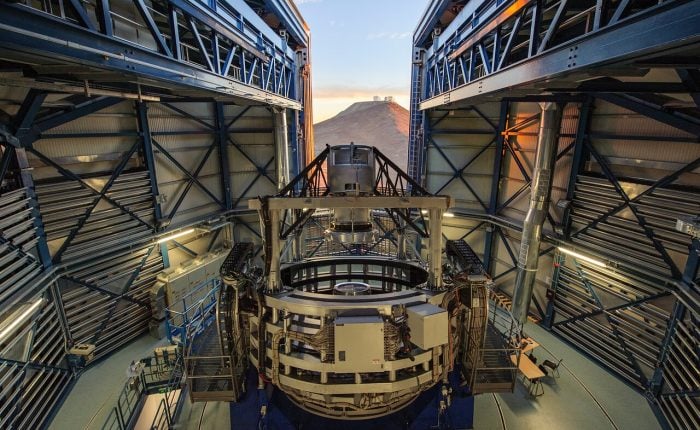
A large telescope - 4MOST - is seen pointing to the sky from its structure in Chile.

‘A census of galaxies’: How Australia is helping map our local Universe

Astronomers are using Australian technology, expertise and software to create the most complete galaxy census of the local Universe.
Book cover of Lost in Space: Curiously Cosmic Stories by Dr Kirsten Banks

GIVEAWAY: Win a copy of Lost in Space by Dr Kirsten Banks!

Win a copy of Lost in Space by Dr Kirsten Banks with Astronomy Australia Limited!
Call for Applications – AAL Committees

AAL is seeking applications from members of the astronomy community and other suitably qualified individuals keen to serve in one of several capacities. AAL is...